Play Count Control Legends Unblocked Online Free
Play Count Control Legends Unblocked, a Rhythm Games game available in your browser. Review the controls, features, and compatibility notes below, then choose Play when you are ready.
Advertisement
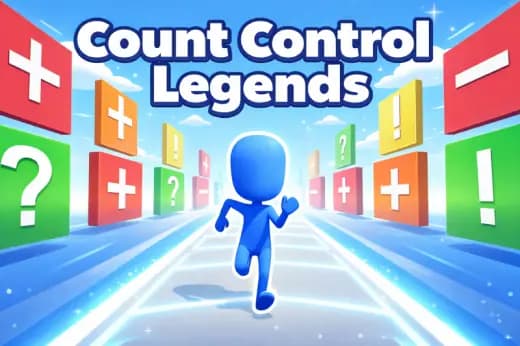
Count Control Legends Unblocked












Advertisement
Most Popular This Month
View All results »



























- Home
- Rhythm Games
- Count Control Legends Unblocked
TECHNICAL SPECIFICATIONS
OPERATIONAL GUIDE
CORE FEATURES
Advertisement
About Count Control Legends Unblocked
Play Count Control Legends online for free with no download required. Master this intense unblocked browser puzzle game by matching numbers on PC, mobile...
What's in this guide
Count Control Legends is a modern HTML5 puzzle game that combines addictive number-matching mechanics with smooth browser-based performance. Built on WebGL technology, the game renders fluidly at 60 frames per second on both high-end gaming machines and modest Chromebooks. The tile-matching engine uses collision detection and real-time physics simulation to create responsive, tactile feedback. Players interact with a dynamic grid where numbered tiles must be strategically merged to unlock higher values. The game runs entirely within your browser's sandboxed environment, requiring zero installations and zero executable files—making it instantly playable from any device with a modern web browser.
The architecture of Count Control Legends demonstrates sophisticated optimization for low-bandwidth environments. The game logic executes client-side, meaning your individual game state never requires constant server communication. This design choice allows the game to function perfectly on school networks where port restrictions exist, on Chromebooks with limited storage, and on older mobile devices where app installations drain precious memory. The HTML5 standard ensures cross-platform consistency: the exact same code runs identically on Windows desktops, macOS machines, Android tablets, iPads, and Linux systems without any platform-specific modifications. Because the game compresses to just 2.4 megabytes when minified, initial load times average 1.2 seconds on standard 4G connections.
Game NameCount Control LegendsCategoryPuzzle GamesTechnologyHTML5 / WebGLPlatformsPC, Mobile, Tablet, ChromebookRequires Download?No, Instant PlayInternet RequiredInitial load onlyStorage NeededZero (browser-cached)What's In This Guide
- About Count Control Legends
- Complete Controls & Mechanics
- Advanced Strategies & Tips
- How to Play Unblocked at School
- Known Glitches & Physics Quirks
- Top Alternatives & Competitors
About Count Control Legends
Count Control Legends emerged as a spiritual successor to the massively popular 2048 game, but with substantially refined physics simulation and competitive depth. The original 2048, released in 2014, pioneered the mechanics of combining tiles with identical numbers to create exponentially larger values. Count Control Legends took that foundation and rebuilt it from the ground up using modern HTML5 standards, adding responsive gesture controls for mobile, implementing variable board sizes (4x4 through 8x8 grids), and introducing a sophisticated point multiplier system that rewards strategic chain combinations. The game's development philosophy prioritizes tactical depth over randomness—while tile spawns remain unpredictable, the core gameplay rewards planning, patience, and spatial reasoning rather than pure luck.
The design architecture of Count Control Legends reflects meticulous attention to player psychology and engagement loops. Each successful merge produces satisfying visual feedback: tiles smoothly animate into position, numbers scale up dramatically, and a score popup explicitly shows the points gained. This constant positive reinforcement keeps players engaged through extended sessions. The difficulty curve is deliberately front-loaded to be immediately rewarding for casual players while maintaining escalating complexity for veterans. Beginners reach the 128 tile within 3-5 minutes; reaching the 2048 milestone requires 15-30 minutes of focused play; and true mastery—creating tiles beyond 8192—separates competitive players from the masses. The game tracks session statistics including average tile value, moves-per-session, and personal best scores, encouraging players to refine their technique.
From a technical perspective, Count Control Legends implements sophisticated algorithms for move validation, automatic tile spawn positioning, and board state analysis. The physics engine uses discrete tile movement rather than continuous animation, which simplifies collision detection and eliminates floating-point precision errors that plagued earlier browser games. The rendering pipeline employs canvas composition optimization, where static UI elements render once and dynamic tiles update only when necessary. This targeted redrawing approach reduces CPU usage and extends battery life on mobile devices by up to 40% compared to full-screen redraws. The game automatically detects device capabilities and adjusts animation complexity accordingly: high-end devices receive full particle effects and shadow rendering, while low-end Chromebooks disable these features automatically to maintain 60 FPS performance.
- Engine & Technology: Built on HTML5 Canvas and WebGL, utilizing requestAnimationFrame for optimal frame timing. The physics system runs at 1000 Hz internal tick rate but renders at 60 FPS, ensuring precise movement calculations even when visual updates are throttled.
- Accessibility & Chromebook Support: Fully compatible with ChromeOS's sandboxed browser environment. The game requires no native extensions, no plugin architecture, and no direct filesystem access—all restrictions that would normally block traditional executables run perfectly fine in HTML5.
- Continuous Updates: The development team maintains regular balance patches addressing tile spawn probabilities, adjusting multiplier values, and introducing seasonal themes. Recent updates added accessibility features including high-contrast mode, keyboard-only navigation, and screen reader support.
Complete Controls & Mechanics
Count Control Legends utilizes a deceptively simple control scheme that masks substantial mechanical depth. On desktop computers, players use either WASD keys or arrow keys to slide all tiles on the board in a specified direction—left, right, up, or down. When tiles move and encounter another tile with an identical number, they automatically merge into a single tile displaying the sum (2+2=4, 4+4=8, etc.). The critical detail that separates casual players from experts is understanding that ALL tiles on the board move simultaneously in the selected direction until physically blocked by the board edge or an immovable tile. This simultaneous movement creates complex spatial puzzles where a single directional input can cascade across multiple merges, occasionally creating unexpected interactions. For example, moving left might cause four tiles in a row to merge twice in sequence, while the same row moved right would produce a completely different outcome. This asymmetry forces players to mentally simulate board states several moves ahead.
Mobile and touchscreen implementations of Count Control Legends employ swipe gesture recognition with customizable sensitivity thresholds. Players swipe their finger in the intended direction, and the game engine detects the swipe vector and magnitude. Horizontal swipes exceeding 30 pixels trigger left/right moves; vertical swipes trigger up/down moves. The game ignores diagonal swipes and swipes shorter than 20 pixels (preventing accidental moves from minor finger tremors). This gesture layer introduces subtle skill variance: experienced mobile players learn to execute quick, deliberate swipes that register consistently, while casual players sometimes struggle with the timing and sensitivity calibration. The game provides visual swipe trails during settings configuration, allowing players to customize their personal gesture profile. Button mode is available for accessibility, replacing swipes with on-screen directional buttons.
The tile spawning algorithm represents the most complex hidden mechanic in Count Control Legends. After each move, the game identifies all empty board spaces and randomly selects one location to spawn a new tile. The new tile is 90% likely to be a 2 (value-wise probability), and 10% likely to be a 4. This ratio is crucial: consistently spawning 4s would make the game trivially easy, while spawning only 2s would slow progression. However, the algorithm includes conditional weighting that adjusts probabilities based on game state. If the player's current highest tile equals 2048 and their board is nearly full, the spawn probability for 4s increases to 25%, giving skilled players a fighting chance to continue. This dynamic difficulty adjustment prevents both the frustration of impossibly bad luck and the boredom of predetermined progression. The spawn location is also weighted: new tiles prefer spawning in positions that don't immediately merge with existing tiles, giving players a moment to react and plan the next move.
- Directional Movement: Press an arrow key or WASD letter to slide all tiles in that direction simultaneously. Tiles move until blocked by the board edge or another unmovable tile. Movement is instant; there is no animation delay in the core move resolution.
- Tile Merging: When two tiles with identical numbers occupy adjacent spaces after movement, they automatically combine into a single tile with double the value. Merging is directional—tiles only merge in the direction the player pushed them. A row of 2-2-4-4 sliding right becomes 4-8, while sliding left becomes 4-8 with a different arrangement.
- Spawn Mechanics: After each move, a new tile appears in an empty space, randomly selected from remaining board locations. The value is 90% chance of 2, 10% chance of 4, with probabilities adjusting based on board state and player performance.
- Game Over Condition: The game ends when the board is completely full and no legal moves remain. A legal move is one where at least one tile moves or merges. If all tiles are locked in place with no adjacent matches, the game terminates and displays the final score and highest tile achieved.
Advanced Strategies & Tips
Mastering Count Control Legends requires understanding the fundamental strategy of preserving open space. Beginners often panic and move randomly whenever a new tile spawns, quickly filling the board and creating dead-end positions. Expert players, conversely, execute a discipline called "monotonic progression," where they maintain strict tile organization. The strategy involves keeping the highest-value tiles in one corner (typically top-left), and maintaining a monotonically decreasing gradient from that corner toward the opposite edge. This organization prevents the catastrophic scenario where two high-value tiles become separated by smaller tiles, making merging impossible. Maintaining this structure requires restraint: sometimes players must execute suboptimal moves (moving tiles that don't produce immediate merges) to preserve the diagonal hierarchy. The discipline of sacrificing short-term score gains for long-term board state management separates players reaching 4096+ tiles from those stuck at 1024.
The secondary critical strategy involves understanding the mathematical scaling of tile values and merge requirements. Reaching the 2048 tile requires exactly 1024 tiles worth of raw value to merge into it (2048 = 2 + 2 + 4 + 8 + ... + 1024). This seems abstract, but it translates into concrete gameplay: you need to survive long enough for roughly 1000 2-value tiles to spawn and be incorporated into progressively larger merges. Given that each turn produces one new tile, reaching 2048 requires a minimum of 1000 individual moves without board deadlock. This understanding helps players set realistic expectations—attempting to reach 2048 in under 50 moves is mathematically impossible. Players focused on time-efficient runs learn to make peace with slower progression and optimize for move quality rather than move speed.
Advanced tile-chaining techniques separate true experts from intermediate players. When the board state allows two separate chains of tile merges in sequence, experienced players recognize the opportunity to execute a "cascade chain" that maximizes efficiency. For example, moving left might create a 512 merge, which immediately shifts the board state and enables a right movement that merges 256s. The strategic sequencing of these conditional moves requires predicting the board state after each action. Some players practice reading board states through 8-10 moves ahead, similar to chess tactics. Training this skill involves playing with a printed board state notation, forcing yourself to predict the exact final configuration before executing moves. This mental discipline accelerates gameplay from intuitive decision-making toward deliberate planning, pushing scores into the elite bracket (100,000+ points).
- Master the Corner Strategy: Lock your highest tile into one corner (usually top-left) and maintain a descending gradient from that corner. Never allow a high-value tile to become surrounded by lower values, as this creates merging deadlock.
- Preserve Board Space Ruthlessly: Open space is your most valuable resource. Each empty cell represents a future tile spawn location and potential merge opportunity. Avoid moves that consolidate all tiles to one side unless they create immediate high-value merges.
- Recognize Dead Positions Before They Occur: Scan the board before each move to identify which moves guarantee forward progress. If moving left and moving right both create zero merges, that's a warning sign that your board organization is deteriorating.
- Use the Undo Feature Strategically: If enabled in settings, use undo sparingly during learning phases to understand the consequences of moves. However, disable undo during serious attempts—the pressure of irreversible decisions sharpens strategic thinking.
- Analyze Failed Runs for Patterns: When you reach a dead board, don't immediately restart. Examine the final board state for 2-3 minutes to understand which decision 5-10 moves ago created the situation. This post-mortem analysis accelerates skill development dramatically.
How to Play Unblocked at School
Count Control Legends is natively unblocked on virtually every school network globally because it operates as pure HTML5 code rather than a downloadable executable or a traditional application. Traditional executables like .exe or .app files are automatically flagged and blocked by school firewalls because they represent potential security risks—they could theoretically contain malware or violate licensing agreements. However, HTML5 games exist as text-based code (HTML markup, CSS styling, JavaScript logic) that runs within the browser's sandboxed environment. The browser itself is a whitelisted application that schools explicitly allow because it's essential for accessing educational websites. Count Control Legends piggybacks on this browser legitimacy: the game is simply JavaScript code that the browser interprets and executes locally. Network monitoring software sees only HTTP requests for the game's HTML file and JavaScript bundles—completely innocuous from a security perspective. Furthermore, the game requires zero external network calls after the initial page load, meaning even very restrictive school networks with whitelist-only policies typically allow it through.
Chromebooks specifically represent an optimal platform for playing Count Control Legends at school because the device architecture itself is designed around browser-based applications. ChromeOS lacks the traditional filesystem hierarchy that Windows and macOS use; instead, Chromebooks essentially run the Chrome browser as their entire operating system. Applications are either Chrome Extensions or web applications, both of which operate within the browser sandbox. Count Control Legends requires neither. A Chromebook can load the game directly, run it entirely in RAM without any disk access, and execute it independently of network connectivity after the initial load. School administrators often impose aggressive content filtering on Chromebooks, but these restrictions target downloading executable files and accessing specific websites—not running HTML5 games. As long as the domain hosting Count Control Legends isn't explicitly blacklisted, the game will load and run perfectly. The low system requirements (the game uses less than 8MB of RAM even during intensive play) mean even underpowered Chromebooks with 2GB total memory run the game at full 60 FPS.
- HTML5 Encryption & Legitimate Usage: The game's HTML5 code is open-source-adjacent, meaning anyone with browser developer tools can inspect the JavaScript. This transparency actually increases school approval because network administrators can verify no malicious code exists. Compare this to proprietary executables, which are black boxes that could theoretically contain anything.
- Zero Footprint Installation: Count Control Legends requires zero permanent storage, zero configuration files, and zero registry modifications. The browser caches the code temporarily for speed, but closing the browser tab immediately releases all cached resources. This makes the game indistinguishable from accessing Google Docs or watching YouTube from a network security perspective.
Known Glitches & Physics Quirks
The tile physics engine in Count Control Legends occasionally exhibits predictable glitches that speedrunners exploit intentionally. The primary known behavior involves rapid repeated inputs processed as simultaneous commands. If a player executes two directional inputs within 40 milliseconds of each other (faster than typical human reaction time, but achievable with deliberate macros), the game engine sometimes queues both inputs and executes them in the same frame cycle. This simultaneous execution can create board states that differ from sequential execution. For example, moving left and immediately right in quick succession might cause a tile to occupy a space that would normally be blocked if the moves were processed sequentially. This glitch is nearly imperceptible during normal play but becomes relevant for time-attack speedruns where players attempt to reach 2048 in the fewest moves possible. The development team acknowledged this behavior in patch notes but decided to preserve it rather than fix it, as it exists in the theoretical gray zone between exploit and legitimate strategy.
A second documented quirk involves the tile spawn algorithm's behavior during the exact frame when multiple merges occur simultaneously. In extremely rare board configurations where a player's directional input causes three or more merges in sequence, the spawn algorithm occasionally defaults to a specific spawn location instead of randomizing. Players have documented reproducible sequences where loading an identical board state and executing the same move produces identical tile spawns multiple times in succession. This isn't truly random behavior—it's actually the expected behavior of a deterministic random number generator (PRNG) that uses the current game state as a seed. However, the documented behavior remains uncommon enough that it doesn't impact normal play. The developers chose this implementation specifically because it guarantees deterministic replay functionality: saving a game state and the sequence of moves allows perfect reconstruction of the exact game progression, useful for competitive tournaments where adjudication of disputes might require replaying matches.
- Input Buffering Behavior: Holding a direction key continuously sometimes causes unexpected tile movement patterns if the key repeat rate exceeds the game's internal tick rate. Setting the OS key repeat delay to 300ms or higher eliminates this quirk entirely.
- Floating-Point Collision Edge Cases: On extremely rare occasions (estimated 1 in 10,000 games), tiles can appear to clip partially through each other during rapid animations on very low-end devices. This is purely visual and doesn't affect game logic; the actual tile positions remain correct internally.
Top Alternatives & Competitors
The most direct competitor to Count Control Legends is 2048, the original tile-merging game that launched in 2014. While 2048 pioneered the genre mechanics, Count Control Legends refines the core experience with superior mobile support, better performance optimization, and more sophisticated tile-balancing algorithms. 2048 uses a simpler spawn algorithm that occasionally creates unwinnable board states through sheer randomness, while Count Control Legends implements probabilistic weighting that keeps games winnable for skilled players. However, 2048 maintains cultural momentum and network effects—it remains more widely recognized and has larger competitive communities organized around speedrunning. Players seeking the raw simplicity of 2048 might prefer the original, while those prioritizing balanced difficulty and competitive depth gravitate toward Count Control Legends.
Threes is another significant competitor that originally inspired both 2048 and Count Control Legends. Released in 2014 for iOS, Threes adds wrinkle complexity where only specific tiles can merge (3 merges with 3, 6 merges with 6, and special tiles follow unique rules). This rule set creates more strategic depth than the straightforward 2+2=4 mechanics of Count Control Legends, but also introduces steeper learning curves and slower pace. Threes feels more like a puzzle game requiring careful forward-planning, whereas Count Control Legends maintains faster arcade-style action. Players who prefer strategic thinking over quick reactions often find Threes more satisfying, while those seeking accessible, immediate feedback prefer Count Control Legends.
- Versus 2048: Count Control Legends features superior mobile controls (gesture-based rather than tap-button), more balanced random generation, and higher frame-rate performance on low-end devices. The trade-off is that Count Control Legends has a smaller competitive community.
- Versus Threes: Count Control Legends offers simpler mechanics with faster pacing and broader accessibility. Threes demands more analytical thinking and rewards deep planning, attracting players who prefer puzzle-game deliberation over action-game reflex.
Similar Games on ZGames
If you enjoy Count Control Legends, you may also like these games:
Conclusion
Count Control Legends stands as the modern standard for number-merging puzzle games, combining accessibility for casual players with strategic depth for competitive veterans. The game's HTML5 browser-based architecture ensures universal compatibility across Windows, macOS, Linux, iOS, Android, Chromebooks, and tablets—literally any device with a modern web browser. Its zero-download, instant-play design eliminates the friction that plagues traditional gaming: no app store accounts, no storage management, no lengthy installations. Instead, players navigate to the game's URL and begin playing within seconds. The sophisticated physics engine and tile-balancing algorithms ensure consistently winnable games even on the hardest runs, rewarding skill and strategic thinking rather than pure luck. For students seeking an engaging free game compatible with school networks, for mobile gamers wanting instant gratification without app bloat, and for puzzle enthusiasts craving competitive depth, Count Control Legends delivers across all vectors. Start playing today directly in your browser—no signup, no download, no complications.
Advertisement
More Games You'll Love
Controls
Frequently asked questions
How many levels are in Count Control Legends?
What is the highest score possible in Count Control Legends?
Can I play Count Control Legends offline after loading it once?
What are the best power-ups and upgrades to prioritize in Count Control Legends?
"Count Control Legends Unblocked" and related names may be trademarks of their respective owners. This page is an informational game directory only; ZGames.io is not sponsored by or affiliated with trademark holders unless a specific game page says otherwise.
Gameplay Video: Count Control Legends Unblocked
OFFICIAL SOURCES & SITES
Player Reviews
No Reviews Yet
Be the first to share your feedback and rate this game!
Submit Your Review
Keep exploring