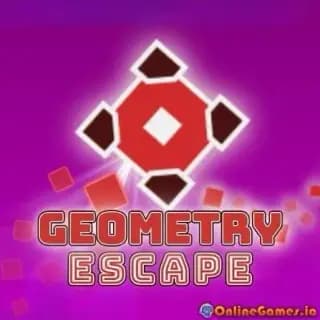
Play Geometry Escape Online Free
Play Geometry Escape, a Arcade game available in your browser. Review the controls, features, and compatibility notes below, then choose Play when you are ready.
Advertisement














Advertisement
Most Popular This Month
View All results »






























Geometry Escape
TECHNICAL SPECIFICATIONS
OPERATIONAL GUIDE
- 1. Time your ground jumps
Watch the spacing of spikes and pits and tap Space, click, or tap the screen just before your cube reaches each hazard, learning exactly how far a single jump carries you.
- 2. Stabilize rocket flights
In rocket sections, hold your input to rise and release to fall, using short, controlled presses instead of long holds so you can trace a smooth line through tight gaps.
- 3. Adjust to gravity flips
When the level flips and your cube runs on the ceiling, keep using the same jump button but mentally re-label the ceiling as the new floor so your usual timing logic still applies.
- 4. Collect coins on safe runs
Once you can reliably reach a coin’s location, start nudging your jump timing or rocket path to pick it up, then finish the level to bank it toward new cosmetic skins.
- 5. Practice reading patterns ahead
Keep your eyes slightly in front of the cube to recognize obstacle patterns early, then use repeated attempts to refine exactly when to press so entire sections become automatic.
CORE FEATURES
Advertisement
About Geometry Escape
Play Geometry Escape online and guide a fast-moving cube through 30 trap-filled levels. Time your jumps, rocket flights, and gravity flips to survive each...
What's in this guide
Geometry Escape stands out in the crowded field of arcade games by stripping platforming down to a single input and then pushing that one mechanic as far as it will go. Your cube never stops moving; all you control is when and how long you press. From that tiny decision, every close call, every brutal failure, and every perfect run is born.
If you enjoy Geometry Dash–style challenges, this version focuses hard on pure mechanical execution. No gimmicky story, no menus full of modes—just 30 escalating levels that ask: can you keep your nerve and hit the right frame, again and again, all the way to the finish?
This guide looks at Geometry Escape online from the inside out: how its auto-run system works, what that means for your fingers, and how you can shape simple taps into consistent clears. We’ll also touch on coins, skins, and a few level-independent tactics that make tough sections far less intimidating.
Quick facts about Geometry Escape’s arcade setup
| Game | Geometry Escape |
|---|---|
| Category | Arcade / auto-run platformer |
| Technology | HTML5 |
| Developer | FreezeNova |
| Levels | 30 progressively harder stages |
| Core Input | Single-button jump and hold-to-fly |
| Primary View | Side-on 2D with geometric obstacles |
The constant-run system that defines Geometry Escape
Everything in Geometry Escape starts with one rule: your cube is always moving forward. You never slow down, never reverse, and never stop unless you die or hit the goal. This turns each level into a side-scrolling obstacle script that you learn by feel.
Auto-running and obstacle pacing
Because the cube’s speed is fixed, the game can choreograph spikes, pits, and saws around precise timings. When you reach a certain tile, the game knows exactly how long it’ll take before you hit the next hazard. That’s why a jump that feels barely possible is actually fair once you’ve seen it a few times—your cube’s pace is consistent.
Sources describing this HTML5 build highlight three big obstacle families:
- Spikes and pits that punish late or early jumps.
- Moving traps like saws or shifting blocks that create small safe windows.
- Tight corridors in rocket or gravity sections where your position control must be exact.
Because the speed is predictable, Geometry Escape becomes a game of rhythm and pattern recognition rather than random reflex tests.
One mistake resets the whole level
Most portals emphasize that Geometry Escape does not use traditional checkpoints. Crash anywhere and the level restarts from the first tile. That makes every hazard matter; a stray spike at the tail end of a run can cost you a long streak of perfect inputs.
This can feel harsh at first, but it has a subtle upside: each restart gives you another pass at everything you’ve already cleared. Over time, sections you once feared become automatic, and your mental focus narrows to the newest obstacle that’s still giving you trouble.
Controls and inputs: how Geometry Escape actually plays
While different sites mention slightly different key options, they all agree that Geometry Escape uses a single-button control approach. You press to jump, and in certain segments, holding instead of tapping makes your cube fly.
Geometry Escape controls on desktop
- Spacebar – primary jump key; tap to jump, hold to fly during vehicle sections.
- Left mouse click – works the same as Space; click to jump, hold to fly.
- W or Up Arrow – alternative jump keys mentioned on some education-oriented portals.
Functionally, all of these inputs send the same signal to the game. You can experiment and pick whichever Geometry Escape controls feel most comfortable for your hand position.
Touch controls for mobile and tablet
- Tap the screen to make your cube jump.
- Hold your finger down to stay in the air during rocket-style flying segments.
This means you can play Geometry Escape online on a phone or tablet with the same timing you’d use on a keyboard. The key difference is how precise your finger is compared to a key press, so give yourself a few levels to adjust if you switch devices.
Core gameplay loop: from floor jumps to rocket routes
Every Geometry Escape run is built from a small handful of mechanical pieces. Understanding how each one behaves will make new levels feel familiar even when the layouts change.
Grounded cube jumps
On the ground, the cube behaves like a traditional platformer character with simplified physics. Tap your button once to launch into a preset jump arc. You don’t have mid-air steering, and the distance is determined by how fast you’re moving horizontally, which is fixed.
What you can control is when you leave the floor. That timing determines:
- Whether you clear a spike or clip its edge.
- Whether you land on a safe platform or fall into a pit.
- How you chain jumps across platforms with different heights.
In early levels you’ll mostly see single spikes and simple gaps. As you progress, the game strings these together—double spikes, spikes at the edges of tiny platforms, or sequences that require jumping on rhythm.
Rocket and flight segments
FreezeNova’s description notes rocket-style sections where your cube transforms into a vehicle. Here the inputs change from discrete jumps to continuous height control:
- Hold your key, mouse, or touch to rise.
- Release to fall.
The forward speed remains constant, so your job is to draw a safe path through the level’s airspace. Flying sections often introduce:
- Spike ceilings and floors that pinch towards the middle.
- Narrow vertical tunnels that force careful rising and falling.
- Mixed patterns where the safe route zigzags up and down.
Unlike jumps, which are all about split-second presses, rockets reward smooth, light adjustments. If you find yourself over-correcting, try short taps instead of a long hold.
Gravity flips and upside-down running
Some later Geometry Escape levels flip gravity, sending your cube to the ceiling. Despite the visual shake-up, the mechanics stay consistent: your cube still auto-runs, and your jump still sends you away from the surface you’re on.
This creates interesting decisions:
- Spikes might line the floor while you run safely on the ceiling.
- Pits become ceiling gaps that you must jump down into rather than over.
- Transitions can flip gravity mid-jump, asking you to keep track of where “down” currently is.
To adapt, think in terms of surfaces. Instead of asking “am I up or down?” ask “which line am I running on, and where is the danger relative to that?” This mental shift keeps your jump timing logic intact.
Speed boosts and tightening windows
Descriptions of the game mention increased speed and boost segments in higher levels. When the game speeds up, the time between hazards shrinks, but your jump height and rocket control remain the same.
Practically, this means:
- Your reaction window for spikes gets smaller.
- Rocket movements move you across the screen faster, amplifying small mistakes.
- Memorization becomes more important, because improvising at high speed is tough.
Speed shifts are where Geometry Escape’s minimalist design shines: nothing changes in the control scheme, yet the feel of each level can be wildly different.
Level progression across all 30 stages
Portals that focus on this HTML5 version agree on a 30-level structure. While they don’t detail each stage, they consistently describe a difficulty ramp rooted in introducing and then combining mechanics.
Early levels: learning the language
The first few levels function as a mechanical tutorial, even without text on the screen. You’ll see:
- Single spikes that show you how far a normal jump travels.
- Simple pits that teach you not to jump too late.
- Generous landing platforms that forgive minor timing errors.
Take advantage of these stages to experiment with your preferred input—Space, click, or touch—and learn how quickly the cube falls after a jump.
Mid-game levels: mixing jumps, flights, and flips
As you unlock more stages, Geometry Escape starts layering in its twists:
- Short rocket segments interleaved with normal running.
- Gravity flips that make you re-evaluate familiar hazard patterns.
- Speed changes within a single level.
These mid-game levels are where you begin to think a few hazards ahead instead of reacting one obstacle at a time. Many players find that focusing their eyes slightly in front of the cube, rather than on the cube itself, improves consistency here.
Late levels: precision and mental endurance
By the time you’re closing in on level 30, individual hazards are rarely new. The challenge shifts to stringing everything together under pressure. Long stretches with no checkpoints mean you must maintain focus for extended runs without panicking when you reach a previously deadly section.
This is where Geometry Escape feels closest to rhythm games: you’re essentially performing a memorized input sequence against a visual pattern, with almost no room for improvisation. The satisfaction of finally clearing a level you’ve been stuck on is a big part of the appeal.
Coins, skins, and why collecting is optional
FreezeNova’s feature list mentions coins and unlockable skins, adding a light layer of long-term goals on top of the core platforming.
Where coins appear and what they do
Coins are scattered around levels, often in slightly riskier positions than the main safe route. Collecting them lets you unlock new cosmetic looks for your cube and the vehicles used in rocket-style sections.
Key points about coins and skins based on available descriptions:
- Coins are optional; you can finish a level without grabbing them.
- Skins are treated as visual customizations rather than power-ups.
- The number of coins required per skin isn’t standardized across portals, but they consistently describe a coin-spend system.
This means you can decide how aggressive you want to be. If you’re aiming to beat all 30 stages, you might ignore tricky coins until you’ve mastered a level’s path. If you love cosmetic collecting, you can treat those side routes as an extra challenge layer.
Do skins affect gameplay?
None of the descriptions for this Geometry Escape build mention gameplay changes from skins. They’re framed purely as style choices, so you don’t have to worry about equipping the "wrong" look. Pick the cube or rocket design that you find easiest to track visually against the background.
Practical tactics for consistent clears
Because Geometry Escape uses only one main input, improving isn’t about learning combos—it’s about refining timing and habits. These strategies apply across almost every level.
Train short and long presses separately
On ground sections, you want quick, decisive taps. On rocket sections, you want smooth, controllable holds. If you’re mixing those in your mind, you might accidentally hold too long during a jump or tap too briefly while flying.
Try focusing on one behavior at a time:
- In early levels, exaggerate short taps to make spikes feel easy.
- In early rocket segments, deliberately practice gentle, rhythmical holds and releases.
Once both motions are comfortable, transitions between running and flying will feel much less jarring.
Look ahead of your cube, not at it
Because the cube’s speed is constant, the important information is always slightly ahead of where you are. If you stare at the cube, you’ll react late to new hazards. Instead, try anchoring your vision a short distance in front of the character so you see spikes and gaps just before you reach them.
This small shift is crucial when speed boosts appear, giving your brain a fraction of a second more to process the next jump.
Use repetition instead of brute reflexes
With no checkpoints, it’s tempting to get frustrated when a single obstacle keeps ruining your run. Instead of trying to "react harder," treat each failure as a note in a rehearsal. Ask yourself:
- Did I jump too early or too late?
- Was I holding during a rocket section for too long?
- Did a gravity flip throw off my sense of where the floor was?
Once you identify the mistake, replay the level with that one adjustment in mind. Geometry Escape is very consistent, so a corrected habit will usually work the same way every time.
Learn safe spots for breathing room
Most levels include small stretches of flat ground or open air with no hazards. Use these to mentally reset. Relax your hands, re-focus your eyes ahead of the cube, and prepare for the next tricky sequence rather than coasting on autopilot.
Knowing where these "breather" sections are also makes long levels feel less overwhelming—you’re always just playing to the next safe segment.
Technical notes and accessibility for Geometry Escape online
As an HTML5 Geometry Escape browser game, this version is designed to run in modern web browsers on PC, mobile, tablet, and Chromebook. Portals listing it highlight broad device compatibility rather than any specific install process.
Fullscreen and visual comfort
Most hosts embed the game with a fullscreen toggle in or around the game frame. Playing fullscreen can reduce background distractions and make small spikes easier to see, especially on high-resolution displays or small laptop screens.
If visual overload is an issue, consider lowering your screen brightness slightly and sitting a bit farther back; the game’s high-contrast geometric style can feel intense during long sessions.
Sound and classroom friendliness
Geometry Escape uses music and sound effects to reinforce its rapid pacing. If you’re playing in a shared space or classroom, look for a speaker or music icon in the game frame or simply mute your device. The core mechanics do not rely on audio cues, so you won’t be at a disadvantage playing silently.
How Geometry Escape compares to Geometry Dash–style games
Many portals categorize Geometry Escape alongside Geometry Dash, and that’s a useful reference point: both are side-on auto-runners with single-button jump controls and punishing, no-checkpoint levels.
At the same time, this Geometry Escape browser game keeps its focus tight:
- It offers a fixed set of 30 levels rather than a massive pool of user-made stages.
- Its progression emphasizes learning a contained set of mechanics—jumps, rockets, gravity flips, and speed boosts.
- Its customization layer is light, centered on coin-based skins.
If you’re coming from Geometry Dash, you’ll likely feel at home with the timing and punishment, but appreciate Geometry Escape’s concise, curated level list when you want a defined endpoint to work toward.
Similar games on Z Games if you enjoy Geometry Escape
Once you’ve mastered these 30 levels, there are a few other titles on Z Games that scratch a similar mechanical itch with their own twists.
- Hoop World 3D — another reflex-heavy arcade challenge where clean timing and spatial awareness are the key to threading objects through tight spaces.
- Geometry Dash SubZero Unblocked — expands on the auto-run, tap-to-jump formula with rhythm-synced stages and more elaborate visual effects.
- Flappy Bird Unblocked — offers a simple tap-to-fly control similar to Geometry Escape’s rocket segments, testing how long you can survive in a tight corridor.
- Cookie Clicker Pro — swaps twitch reactions for incremental strategy but shares the satisfaction of small, repeated actions building up to long-term goals.
A final word on mastering Geometry Escape’s one-button design
Geometry Escape proves how deep a single-button game can feel when every level is tuned around precise timing. If you enjoy the process of turning early chaos into muscle memory, these 30 runs offer a clean, focused space to do exactly that.
Advertisement
More Games You'll Love
Controls
Frequently asked questions
How do the rocket sections work in Geometry Escape?
Does Geometry Escape have checkpoints in its levels?
How many levels are in Geometry Escape, and do they get harder?
What do coins do in Geometry Escape?
Are there different game modes in Geometry Escape?
Do Geometry Escape skins change hitboxes or just visuals?
What’s the best way to handle gravity flips in Geometry Escape?
Does Geometry Escape save your level progress between sessions?
"Geometry Escape" and related names may be trademarks of their respective owners. This page is an informational game directory only; ZGames.io is not sponsored by or affiliated with trademark holders unless a specific game page says otherwise.
Gameplay Video: Geometry Escape
OFFICIAL SOURCES & SITES
Player Reviews
No Reviews Yet
Be the first to share your feedback and rate this game!
Submit Your Review
Keep exploring